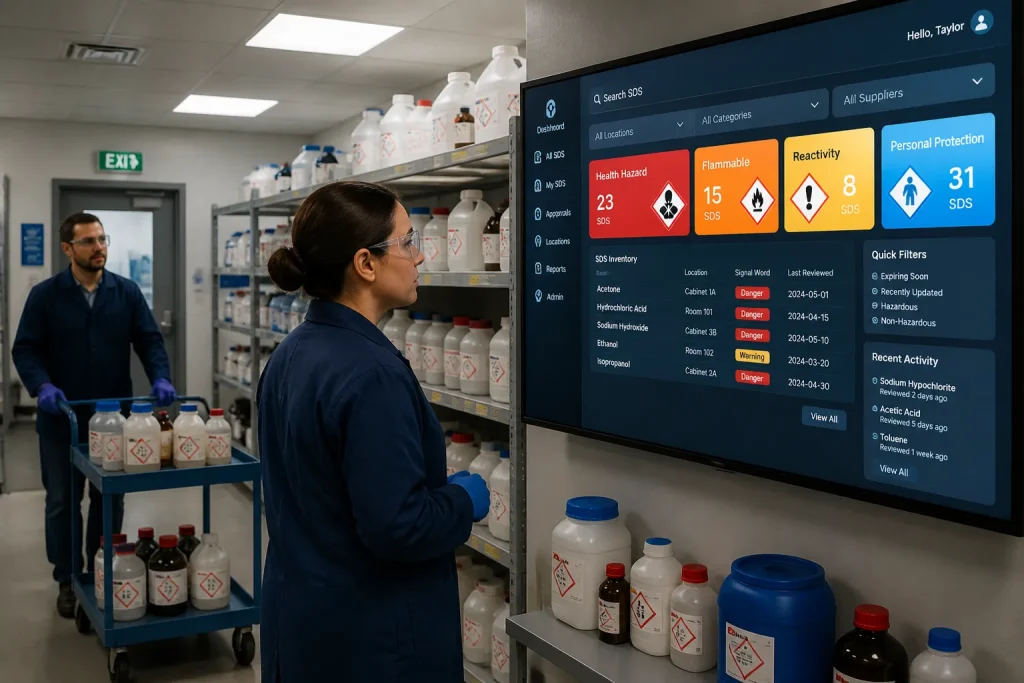
Managing Safety Data Sheets (SDS) with software means using a specialized digital platform to centralize, organize, update, and distribute all your product safety documents automatically. This approach replaces manual methods like spreadsheets and shared folders, reducing errors and ensuring that everyone in your supply chain has access to the correct, most recent information. With a dedicated system, you create a single, reliable source for all safety-related documentation. Read the overview article about managing safety data sheets.
What is involved when you manage Safety Data Sheets using a digital system?
Managing Safety Data Sheets with a digital system involves moving from scattered files to a centralized platform where all safety documents are stored, versioned, and shared in a controlled way. This professional approach, often called electronic SDS management, automates key compliance tasks and provides a clear, auditable history of every document, ensuring your teams and partners always work with the latest safety information. It transforms a reactive, administrative burden into a proactive, streamlined process.
Which tasks are typically covered when you manage safety data sheets with software?
Software automates tasks that are time-consuming and prone to error when done manually. This includes the central storage of all documents, automatic notifications when an SDS is updated, controlled distribution to customers and internal teams, and maintaining a complete audit trail for compliance purposes. It also simplifies finding documents quickly, managing different language versions for various markets, and generating reports on product safety status.
How does managing safety data sheets with software change how versions and updates are controlled?
Software introduces rigorous version control, eliminating the risk of using outdated documents. When a new version of an SDS is uploaded, the system automatically archives the old one and notifies relevant users of the update. Every change is logged with a timestamp and user details, creating a clear history. This ensures that only the current, compliant version is accessible for daily use, while previous versions remain available for auditing and historical reference.
What types of safety data sheets and related documents can be managed?
Our platform allows you to manage more than just the standard 16-section Safety Data Sheets. You can centralize a wide range of product safety documentation, including technical datasheets, detergent declarations, and other product specifications. As mentioned on our platform's FAQ page, you can also store and link multiple language and regional versions of a document to a single product, ensuring you provide the correct information for each specific market.
How does centralized software to manage safety data sheets work in practice?
In practice, centralized software acts as a single source of truth for all your product safety information, accessible to authorized users anywhere. It streamlines the entire lifecycle of a safety document, from initial upload and indexing to controlled sharing with partners and archival of outdated versions. This ensures consistency and compliance across all your operations.
How are safety data sheets imported, indexed, and stored in a centralized platform?
Safety Data Sheets are typically uploaded directly into the platform. During this process, you add key information (metadata) such as product name, revision date, and language. This indexing makes documents easy to find later using search and filter functions. All files are then stored securely in a central repository, replacing scattered network drives or email attachments.
How does centralized software manage safety data sheets across multiple sites or countries?
A centralized system provides a unified view of all safety documents, regardless of physical location. Teams in different warehouses, offices, or countries can access the same up-to-date information. Our platform specifically supports this by allowing you to manage multiple language versions for a single product, ensuring that teams in each market can access compliant documentation relevant to their region.
Which user roles and permissions are commonly used to manage safety data sheets centrally?
To ensure security and data integrity, systems use role-based permissions. Common roles include Administrators, who have full control over the system and user management; Editors or Contributors, who can upload and manage documents for specific products; and Viewers, who have read-only access to view and download approved documents. This controlled access prevents unauthorized changes and ensures that only trained personnel handle critical safety information.
What key features should software to manage safety data sheets include?
Effective software for managing Safety Data Sheets should provide robust tools for organization, compliance, and distribution. These features are essential for transforming SDS management from a manual chore into an efficient, reliable process that supports your entire supply chain. At ProductSafetyCloud, we focus on providing a platform where data transfer, not just PDF sharing, creates broader possibilities.
- Advanced Search and Filtering: You need to find the right document instantly. Key functionality includes searching by product name, substance, revision date, or other metadata. This saves significant time compared to browsing through folders.
- Automated Version Control and History: The system must automatically manage document versions. It should clearly display the latest version, archive older ones, and maintain a complete, accessible history for every document. This is critical for audits and compliance checks.
- Secure, Role-Based Access: The platform must allow you to control who can view, upload, or edit documents. Setting permissions for different users and teams ensures that sensitive information is protected and that only authorized personnel can make changes.
- Integration and Data Exchange Capabilities: To maximize efficiency, the software should be able to connect with your other business systems, such as ERP or inventory management. Our platform is built on data transfer principles, allowing for deeper integration than simply sharing PDF files.
- Reporting and Analytics: The ability to generate reports is crucial for oversight. This can include tracking which documents are nearing their review date or analyzing products based on hazardous substances, a feature we support to help you assess your product portfolio.
Conclusion
Switching to a specialized software solution for managing Safety Data Sheets marks a fundamental improvement over manual methods. It provides a centralized, secure, and efficient way to handle critical safety information. By automating version control, simplifying distribution, and ensuring compliance, you reduce administrative burdens and minimize risks. With our platform, you can confidently manage and share your safety documents, strengthening communication and trust throughout your supply chain.