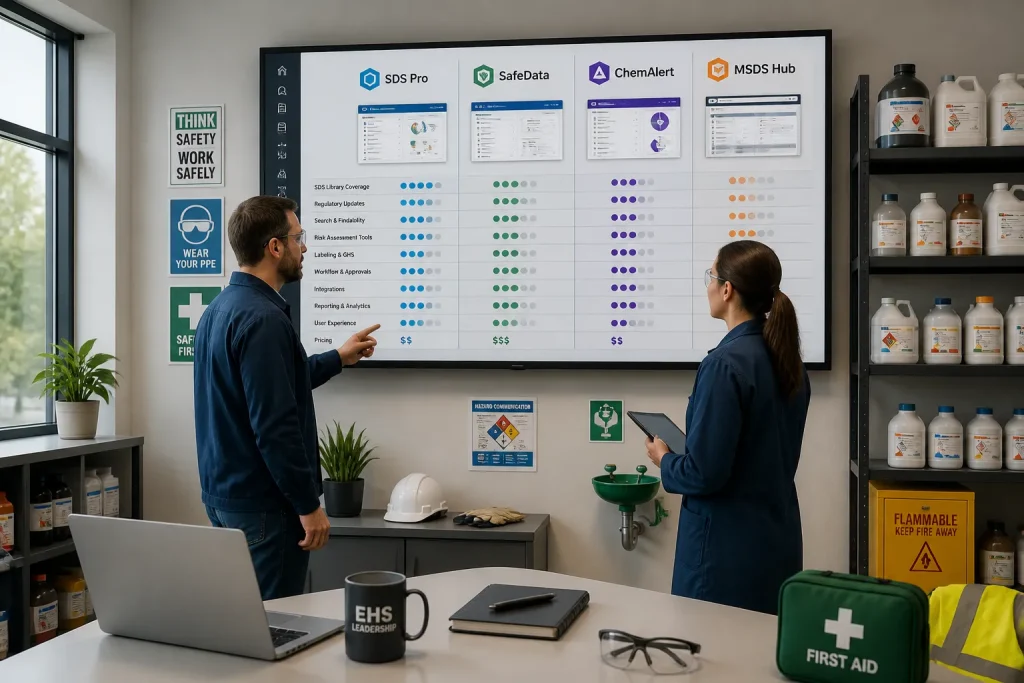
Choosing the right software to manage your Safety Data Sheets (SDS) requires evaluating its ability to centralize data, ensure security, and streamline distribution. An effective platform should provide robust version control, access management, and seamless integration to maintain compliance and efficiency across your supply chain. Read the overview article about managing safety data sheets
What Key Criteria Should You Evaluate When Selecting SDS Management Software?
The most important criteria for selecting SDS management software are centralized document control, robust security features, powerful search capabilities, and ease of distribution. These elements ensure compliance, improve workflow efficiency, and provide a single source of truth for all product safety information. A platform built for the entire supply chain helps manufacturers, distributors, and compliance teams stay aligned.
What are the essential functional criteria?
When you're managing documents for multiple sites or brands, your needs become more complex. Your chosen software should be built to handle this scale. We recommend a checklist to ensure your solution meets these core functional needs:
- Centralized Management & Version Control: The system must handle multiple versions, languages, and regional formats from a single dashboard. Look for features that automatically track changes, archive old versions, and ensure users always access the most current SDS. This prevents the costly mistake of distributing outdated information.
- Advanced Search and Filtering: How quickly can your team or customers find the right document? Effective software should offer powerful search functions, allowing you to filter by product name, GTIN, ingredient, language, or revision date. This saves significant time and reduces the risk of using an incorrect document.
- Integration Capabilities: Does the software connect with your existing systems, such as an ERP or e-commerce platform? API access or other integration options are crucial for automating workflows, like attaching the correct SDS to customer orders or syncing product data automatically.
- Security and Access Control: You should verify the system's security protocols to protect sensitive data. Look for role-based access control to define who can view, edit, or share documents. Furthermore, confirm where the data is hosted. Our platform, for example, is hosted within the European Union to ensure GDPR alignment and uses SSL/TLS encryption for all data transfers.
How Does Managing Safety Data Sheets with Dedicated Software Compare to Using Shared Drives?
Dedicated software for managing Safety Data Sheets offers superior control, accuracy, and efficiency compared to manual methods like shared drives or spreadsheets. It automates versioning, simplifies distribution, and reduces compliance risks, while manual systems are prone to human error and outdated information. This structured approach moves beyond simple PDF sharing to true data transfer, creating more possibilities for senders and receivers.
| Feature | Dedicated SDS Software | Manual Methods (Shared Drives, Spreadsheets) |
|---|---|---|
| Version Control | Automated updates and archiving; ensures only the latest version is accessible. | Prone to error; multiple outdated versions can coexist, causing confusion and non-compliance. |
| Accessibility & Search | Centralized database with powerful search and filtering functions for instant access. | Disorganized files in scattered folders; finding the correct document is slow and unreliable. |
| Distribution | Automated sharing with customers and partners through secure portals or direct links. | Manual process via email, which is time-consuming, difficult to track, and not secure. |
| Compliance & Audit Trails | Built-in audit logs track all views, shares, and changes, simplifying compliance checks. | No systematic tracking, making audits difficult and leaving the company vulnerable to fines. |
| Error Rate | Significantly lower due to automation, validation checks, and a single source of truth. | High risk of distributing outdated documents, broken links, and human data entry errors. |
Which SDS Management Approach Is Right for Your Organization?
The right approach to managing Safety Data Sheets depends on your organization's scale, complexity, and business model. Small distributors may start with a simple system, while large multinationals require a fully integrated, multi-language platform to handle complex supply chains and regulatory demands across different markets.
| Organization Type | Key Challenge | Recommended SDS Management Approach |
|---|---|---|
| Small Distributors | Limited resources and a smaller product range, but still require full compliance. | A free, centralized platform that simplifies sharing and ensures access to the latest versions without significant investment. Focus on ease of use and reliable version control. |
| Large Multinationals | Managing thousands of SDSs across multiple countries, languages, and regulatory frameworks. | An integrated enterprise platform with multi-language support, granular role-based access, API capabilities for ERP integration, and detailed audit trails for global compliance. |
| Online Retailers (No Physical Stock) | Ensuring customers receive the correct digital SDS from suppliers without directly handling products. | A cloud-based data-sharing solution that connects directly with suppliers to pull the latest SDS automatically. The focus is on seamless, automated information flow. |
Conclusion
Choosing the right software for managing your Safety Data Sheets is a critical step toward ensuring compliance and operational efficiency. While manual methods may seem sufficient for very small operations, a dedicated platform provides the security, control, and automation necessary for modern supply chains. By evaluating criteria like centralization, security, and distribution capabilities, you can select a system that scales with your business. We designed ProductSafetyCloud to address these needs, offering a secure, centralized, and easy-to-use solution for clear supply chain communication.